
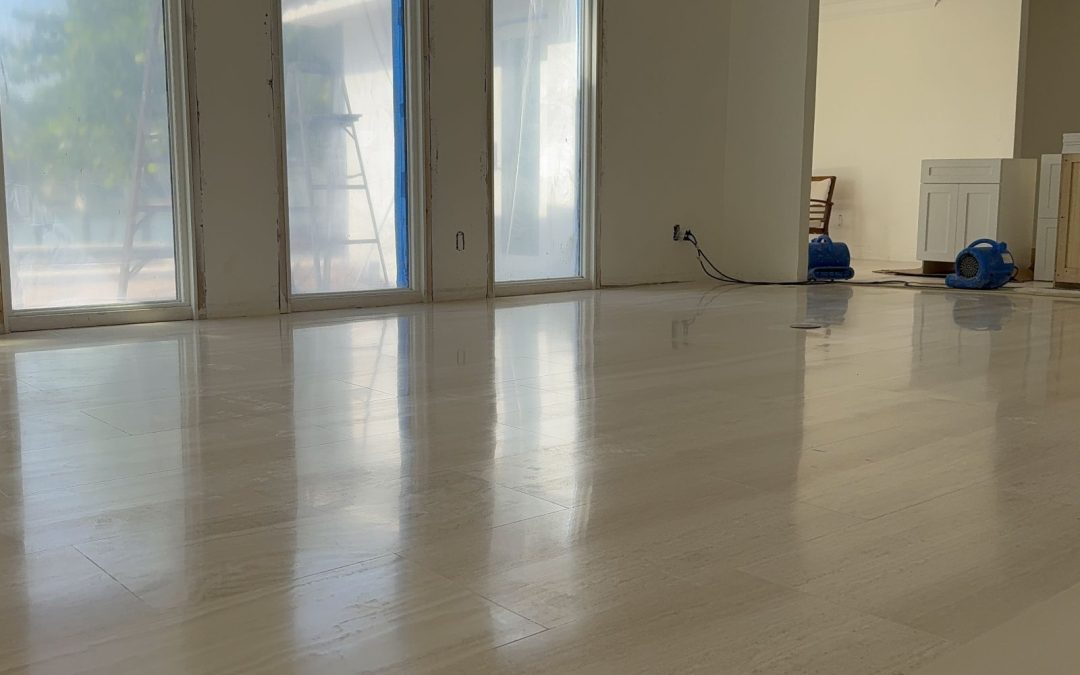
When a commercial floor starts looking worn, scratched, dull, stained, or damaged, the first assumption is often that the flooring needs to be replaced.
But replacement is not always necessary.
Many terrazzo, marble, travertine, limestone, natural stone, and concrete floors can be mechanically restored even after years of heavy traffic and surface wear.
The important question is not simply whether a floor looks old. The question is whether the existing flooring system is still structurally viable and capable of being restored.
For commercial properties in Tampa Bay, understanding the difference between restoration and replacement can help property owners and facility managers make a better long-term flooring decision.
What Is Floor Restoration?
Professional floor restoration corrects the existing surface instead of removing the entire flooring system.
Depending on the material and condition, restoration may involve diamond grinding, honing, polishing, crack and chip repair, stain treatment, densification, sealing, or other material-specific processes.
The objective is to remove or correct the damaged surface, repair defects, refine the material, and restore the desired appearance and performance.
This is very different from routine cleaning.
Cleaning removes dirt and surface contamination.
Restoration corrects the flooring material itself.
If you want a broader explanation of the different materials and restoration processes, see our guide to professional floor restoration.
When Should You Restore a Floor Instead of Replacing It?
Restoration is often worth considering when the floor is physically sound but the surface has deteriorated.
Common signs include:
- Dull or faded appearance
- Scratches
- Etching
- Surface wear
- Stains
- Uneven wear patterns
- Old coatings or buildup
- Minor cracks
- Chips
- Holes or pits
- Loss of polish or clarity
- Heavy traffic lanes
These problems can make a floor look beyond repair even when the underlying material is still serviceable.
A professional evaluation can determine how much of the existing surface needs to be corrected.
Terrazzo: One of the Best Examples of Restoration vs. Replacement
Terrazzo floors are particularly well suited to restoration because the flooring system itself can have a very long service life.
Older terrazzo floors can develop scratches, staining, worn areas, cracks, holes, trench damage, and loss of clarity.
That does not automatically mean the terrazzo needs to be demolished.
A professional terrazzo restoration system may include:
- Floor evaluation
- Surface preparation
- Diamond grinding
- Crack and hole repair
- Trench reconstruction when necessary
- Progressive honing
- Mechanical polishing
- Appropriate sealing or protection
In some projects, damaged areas can also be repaired using custom aggregate and color matching.
High End Services & Solutions currently specializes in terrazzo grinding, honing, polishing, crack repair, trench repair and custom color matching for damaged terrazzo floors. (High End Commercial Cleaning)
Learn more about terrazzo restoration in Tampa.
Marble Restoration Instead of Marble Replacement
Marble can look severely damaged even when the stone itself can still be restored.
Foot traffic, acidic substances, improper cleaning products and years of use can create scratches, etching, dull spots and uneven areas.
Replacing marble can be expensive, especially in large commercial spaces.
Professional marble restoration may involve diamond honing, progressive polishing, scratch removal, etch correction and appropriate sealing.
The finish can also be customized.
A property owner may want a high-gloss polished appearance, while another facility may prefer a more natural honed finish.
The restoration process should be selected according to the condition of the stone and the desired final appearance.
See our marble restoration and polishing services for more information.
Travertine and Limestone Can Also Be Restored
Natural stone restoration is not limited to marble.
Travertine and limestone can also develop significant surface wear over time.
Travertine may have:
- Open holes
- Scratches
- Dull areas
- Stains
- Worn traffic lanes
- Uneven surfaces
Limestone may develop:
- Etching
- Scratches
- Lippage
- Surface wear
- Loss of natural clarity
Because natural stones have different hardness, porosity and chemical characteristics, the restoration process needs to be selected according to the specific material.
Using an overly aggressive process can create additional problems.
The correct approach is to identify the stone, evaluate its condition, and establish the appropriate grinding, honing, polishing and protection system.
Concrete: Restoration Can Mean Grinding and Polishing
Concrete floors are another example where replacement is not necessarily the answer.
Commercial concrete floors can become dull, stained, scratched, porous, or heavily worn from years of traffic.
A professional concrete restoration system may include:
- Surface preparation
- Diamond grinding
- Crack and surface repairs
- Progressive polishing
- Densification
- Final polishing
- Guard or other appropriate protection
The result can be a durable polished concrete surface without removing the existing slab.
High End Services & Solutions provides commercial concrete grinding, densification and polishing throughout Tampa and surrounding areas. (High End Commercial Cleaning)
Learn more about concrete floor restoration and polishing.
What Happens When You Replace Instead?
Replacing a commercial floor can involve considerably more than installing new flooring.
Depending on the project, replacement may require:
- Demolition
- Disposal
- Removal of existing materials
- Surface preparation
- New material
- Installation labor
- New adhesive or setting materials
- Extended access restrictions
- Business disruption
- Additional construction work
For a large commercial property, these costs can add up quickly.
Restoration allows the property owner to work with the flooring that is already installed.
That does not mean restoration is always the right answer.
It means replacement should not be assumed before the existing floor has been evaluated.
When Replacement May Actually Be Necessary
There are situations where restoration is not appropriate.
Replacement may be necessary when the flooring system has serious structural problems that cannot be corrected through surface restoration.
Examples may include:
- Major substrate failure
- Severe structural movement
- Extensive moisture-related deterioration
- Material failure beyond the repairable surface
- Improperly installed flooring
- Areas where the existing material is no longer structurally viable
The purpose of a professional evaluation is to determine whether the floor can realistically be restored.
A reputable restoration contractor should not recommend mechanical restoration simply because restoration is their specialty.
Restoration Is More Than Making a Floor Look Shiny
One common misconception is that floor restoration simply means making a floor shiny.
That is not the objective.
A professional restoration system addresses the condition of the surface.
For example, diamond grinding may be necessary to remove damaged material and level uneven areas.
Honing progressively refines the surface.
Polishing creates the desired level of clarity and reflectivity.
Repairs correct cracks, holes, chips and other defects.
Densification may improve the performance of suitable cement-based surfaces.
Sealing or other protection can help protect porous materials from moisture and staining.
The final appearance is only one part of the restoration.
The goal is a properly restored surface that can perform in its intended environment.
Restoration Can Reduce Commercial Disruption
Commercial properties have another major consideration: downtime.
A flooring replacement project can involve demolition, removal and installation activities that interfere with normal operations.
Restoration can often be performed in phases or scheduled around business operations depending on the project.
The exact schedule depends on the floor size, material, condition, repairs and restoration system.
High End Services & Solutions reports that many commercial restoration projects take approximately two to five days, although individual project schedules vary based on the scope of work. (High End Commercial Cleaning)
For larger facilities, phased restoration can also help reduce the impact on employees, customers and tenants.
Restoration Can Preserve Existing Architectural Flooring
Some floors have value beyond their appearance.
Older terrazzo, marble and natural stone floors can be part of a building’s original architectural character.
Replacing those materials can remove characteristics that are difficult to reproduce with modern materials.
Restoration preserves the existing floor while correcting years of surface wear.
This can be particularly valuable in:
- Historic properties
- Hotels
- Schools
- Medical facilities
- Office buildings
- Retail properties
- Condominiums
- Institutional buildings
When the original material can be restored, preservation may be a better option than demolition.
How Much Does Floor Restoration Cost?
There is no universal price for floor restoration.
Cost depends on:
- Flooring material
- Square footage
- Condition
- Depth of damage
- Amount of grinding required
- Repairs
- Accessibility
- Desired finish
- Required protection
- Project scheduling
A lightly worn floor requiring polishing is very different from a heavily damaged terrazzo floor requiring grinding, repairs and complete refinishing.
For terrazzo specifically, we provide a separate guide explaining the major factors that influence terrazzo restoration cost in Tampa.
A professional evaluation is the best way to determine whether restoration makes financial sense for a specific property.
Restoration vs. Replacement: A Simple Decision
A useful starting point is:
If the floor is structurally sound but the surface is worn, restoration may be the better option.
If the flooring system itself has failed, replacement may be necessary.
The decision should be based on the actual condition of the floor rather than appearance alone.
A dull terrazzo floor is not necessarily a failed terrazzo floor.
A scratched marble floor is not necessarily a failed marble floor.
A worn concrete surface is not necessarily a slab that needs to be removed.
The restoration process exists specifically to correct these types of surface problems.
See Real Floor Restoration Projects
The best way to understand what restoration can accomplish is to look at completed projects.
Our floor restoration case studies document projects involving terrazzo restoration, structural repairs, concrete polishing and limestone restoration throughout the Tampa Bay area.
These projects show the condition of the flooring before restoration, the mechanical processes used, and the finished results. (High End Commercial Cleaning)
Professional Floor Restoration in Tampa Bay
High End Services & Solutions specializes in commercial floor restoration throughout Tampa Bay.
Our restoration work includes:
- Terrazzo restoration
- Terrazzo repair and polishing
- Marble restoration
- Marble polishing
- Travertine restoration
- Limestone restoration
- Natural stone restoration
- Concrete grinding and polishing
- Commercial floor restoration
Our approach focuses on mechanical surface correction rather than simply covering worn flooring with a temporary cosmetic solution. The company currently positions itself around more than 30 years of combined industry experience and commercial hard-surface restoration. (High End Commercial Cleaning)
If your floor looks worn but you are considering replacement, have the existing surface evaluated first.
Restore before you replace.
High End Services and Solutions LLC